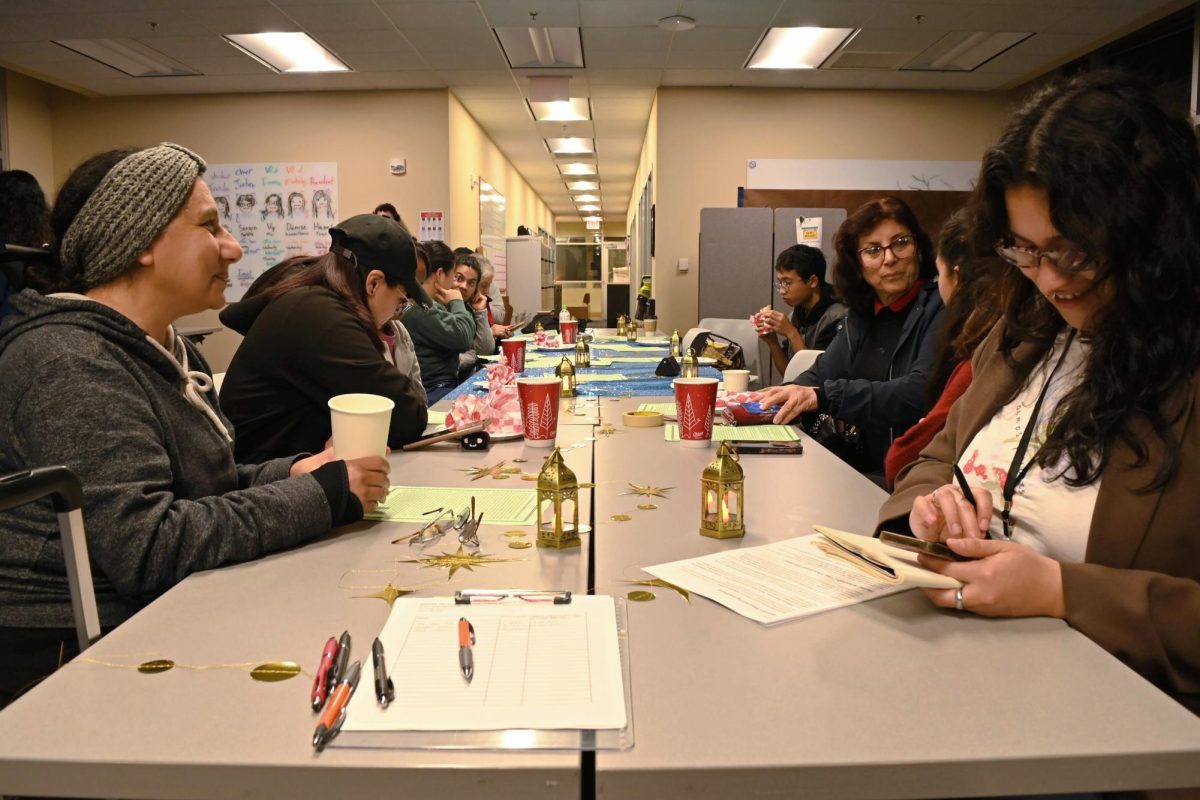
The Middle East, North Africa and Southwest Asian scholars project hosted 1001 Nights: The Power of Storytelling on Nov. 13. Students gathered for an evening of sharing stories and falafel wraps in the Robert N. Chang Student Center.
“One Thousand and One Nights” is a collection of Middle Eastern folklore compiled over centuries and told through different interpretations. Some have even made their way into the mainstream, such as Disney’s “Aladdin.”
Abderrahmene Soufi, a biology major who is part of the MENASA scholar project, believes that the event highlighted the importance of personal narratives, and how storytelling builds community and empathy.
“We picked certain stories that we thought highlighted things that we want to talk about … like the culture in general,” Soufi said. “When you only know one story, that’s how you start looking down on people and all those things like discrimination happen.”
Sonia Coffee, a San Jose City College alumni, was attracted to the event because she thought it correlated with a book she was reading, “Somewhere We Are Human.”
“These two authors, Reina and Sonia, basically got a memoir of all different stories from the undocumented immigrants,” Coffee said about the book. “So to me, it’s like, ‘Oh, this is a beautiful and interesting subject.’ So it should be connected with many stories with them, and I’m going to comment on what is similar and what are the differences.”
Attendees discussed the themes and lessons that the stories offered. Many, such as Mahlet Eshetu, a biology major from Ethiopia, pointed out the similarities between Middle Eastern folklore and popular fables from other parts of the world.
“… A lot of the stories that are trying to be conveyed through these different versions of them are very similar to my culture, where we try to teach each other something from what we’ve lived through,” said Eshetu.
She thinks that stories, no matter the culture, help people connect with one another.
“I think being a student here, sometimes it feels like you’re kind of lost among so many different people,” Eshetu said, “… but when you go to these smaller groups, you’re like, ‘We’re all the same.’ There’s so many different things that we all share, and we connect on those things.”